Innovation doesn’t happen in isolation. It doesn’t live only in meeting rooms, strategy decks, or quarterly plans. And it doesn’t live only in classrooms, theories, or textbooks. Real innovation happens in the space between thinking and doing, when ideas are tested and assumptions are challenged by fresh thinking. That space is where collaboration between the private sector and academic institutions becomes powerful.
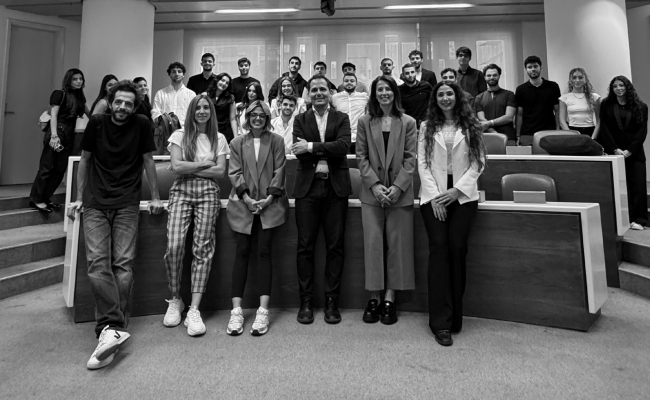
This semester, Wakilni partnered with the American University of Beirut’s Suliman S. Olayan School of Business as part of a newly developed course in Innovation Management. Wakilni was selected as the case study, and students were given a practical challenge rooted in our daily operations: rethinking how we communicate our Golden Rules to drivers clearly and effectively, without overwhelming them.
At Wakilni, a Golden Rule is a client-specific instruction set created to guide deliveries. It includes special notes, preferences, or requirements shared by the client to ensure accurate and consistent handling of their orders. Over time, as operations grew and client needs evolved, these rules expanded. While they remained essential, they also became denser, carrying a lot of important information at once.
The challenge wasn’t about the relevance of the Golden Rules, but about how they were experienced by drivers in real conditions. Drivers often receive these instructions alongside many other operational messages, under time pressure and during active routes. The question the students explored was simple but critical: how do you preserve clarity when the information itself is necessary, but its volume can become overwhelming?
To understand this properly, the collaboration went beyond theoretical work. Throughout the semester, student teams visited Wakilni’s offices in Beqaa, Beirut, and Dekwaneh, where they met with fleet supervisors and operations managers. They observed how Golden Rules are currently communicated, discussed how they are reinforced, and listened to the realities teams face on the ground. Some teams also surveyed drivers to collect direct feedback on how Golden Rules are perceived, which types of instructions are easiest to absorb, and where confusion or fatigue tends to appear. These conversations grounded the project in lived experience rather than assumptions.
By Demo Day, each group presented its perspective on how Golden Rules could be communicated more effectively, whether through clearer prioritization, improved structure, or better timing. Wakilni’s management team joined the session as part of the jury, engaging directly with the students, asking questions, and evaluating the proposals through the lens of operational clarity, feasibility, and real-world impact.
Not every idea is meant to be implemented, and that was never the goal. What mattered was the process itself: seeing familiar systems through fresh eyes and allowing space for constructive questioning.
For the students, the experience demonstrated that innovation doesn’t happen in controlled environments. It happens within imperfect systems, human constraints, and competing priorities. For Wakilni, the collaboration reinforced the importance of pausing to examine everyday practices, especially when they seem to be working.
As Dr. Ziad El-Awad, Assistant Professor of Entrepreneurship at the Suliman S. Olayan School of Business, AUB, reflected: “Companies are often deeply immersed in their own realities, their pressures and boundaries. Collaboration with universities opens a different lens. It challenges assumptions and allows organizations to understand their problems in new ways.”
Opening our operations to an academic lens was ultimately about strengthening how we think about everyday work. Because often, the most meaningful improvements begin with a simple question we don’t ask often enough: why this way?


 Track Orders
